Creating a vibrant new regional park
Mary Bartelme Park

| Location | Chicago, Illinois |
| Client | Chicago Park District |
| Expertise | Research & Design Innovation, Resilience & Sustainability |
| Size | 2.4 acres |
| Completion | 2010 |
Built on the site of a former infirmary, Mary Bartelme Park transformed a full city block in Chicago’s West Loop into a defining piece of civic infrastructure. Completed in 2010, before the neighborhood reached its current density, the 2.3-acre park addressed more than a shortage of open space by establishing a framework for stormwater management, recreation, community identity, and placemaking. Rather than simply responding to the West Loop’s transition from industrial uses to mixed-use development, the park helped shape that evolution by signaling a more livable urban future.
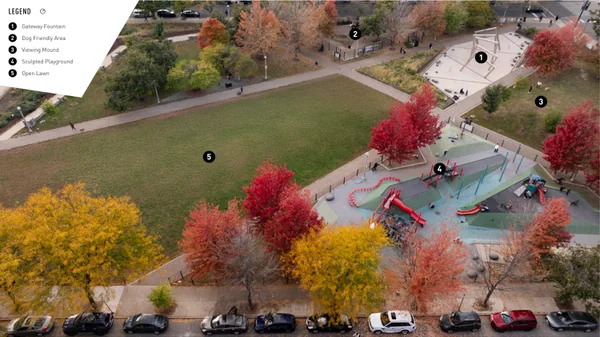

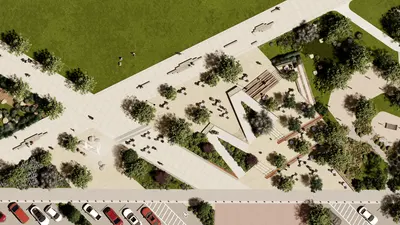
Site Design Group led planning and design efforts in collaboration with the client, city agencies, engineers, and community stakeholders. Community engagement, surveys, and agency coordination informed the program and design, while circulation studies shaped three intersecting pathways that organize spaces, including a contemplative garden, open lawn, dog park, gateway fountain, viewing mound, and playground. Responsibilities included site planning, grading and landform design, planting design, material selection, stormwater management, environmental remediation coordination, and integration of the park’s signature civic features.


As a former industrial property, the site required extensive brownfield remediation and coordination with regulatory agencies. Excavated soils were safely contained within sculpted landforms, while imported clean soil created protective buffers. Existing site constraints, including an underground storage tank, informed the park’s topography and reduced material use, turning environmental conditions into defining spatial features. Sustainability guided the project from the outset, including the goal of eliminating conventional stormwater infrastructure. Permeable paving and subsurface infiltration systems capture and naturally cleanse runoff, managing up to a 100-year storm while reducing demand on the municipal sewer system.
The design responds directly to its West Loop context. Salvaged terracotta artifacts from the former infirmary were incorporated into seatwalls and planting areas, while weathering steel elements reference the neighborhood’s industrial history. Groves of river birch, perennial plantings, and seasonal displays soften the surrounding urban fabric, and a seven-foot-high viewing mound frames views of both the park and the Chicago skyline.
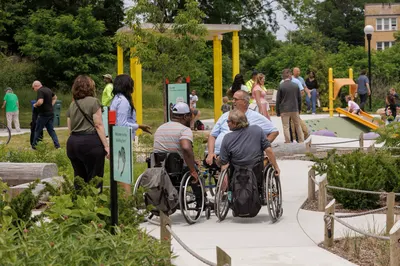
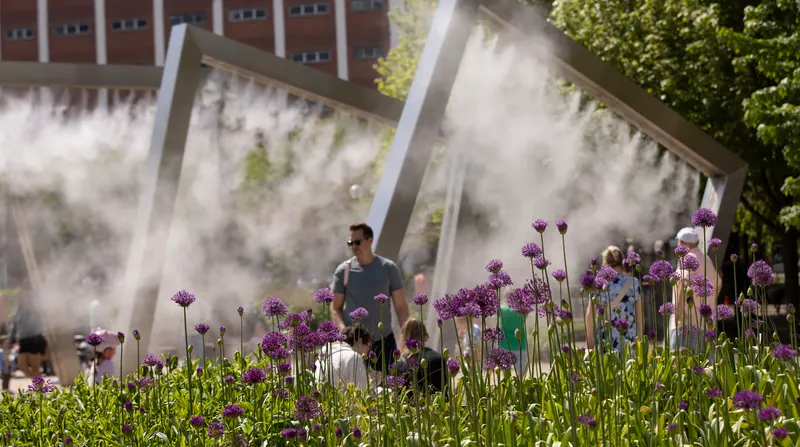
The park’s gateway fountain anchors the northwest corner with five stainless-steel arches that emit a cooling mist. Designed for efficiency, it uses significantly less water than a conventional spray feature while serving as a recognizable neighborhood landmark. Additional amenities—including an accessible playground, open lawn, dog park, contemplative garden, viewing mound, and gathering spaces—support inclusive, multigenerational use and accommodate both daily activity and community events.

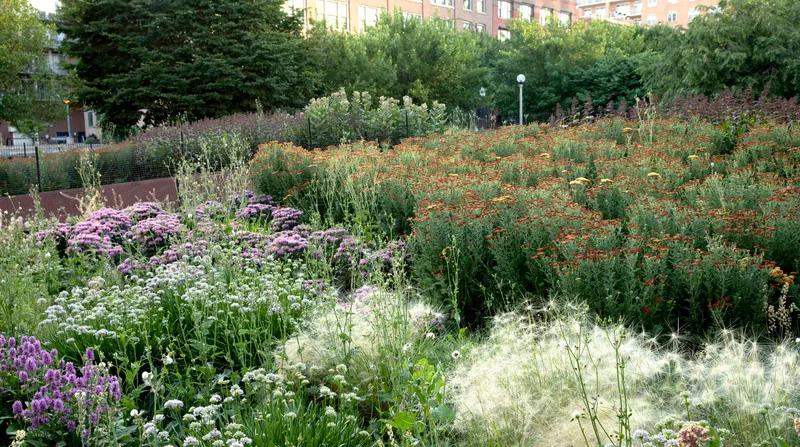



More than fifteen years after opening, Mary Bartelme Park remains a cornerstone of the West Loop, supporting neighborhood growth with shared public space, recreation, environmental performance, and a strong sense of identity. The park also served as an early sustainable design pilot project for the Chicago Park District, helping demonstrate how green infrastructure could be integrated into civic landscapes and establishing precedents for permeable paving and stormwater management across the Park District’s broader network. Mary Bartelme Park demonstrates how landscape architecture can transform environmentally challenged urban land into lasting civic infrastructure that continues to serve the community today.
Collaborators
Terra Engineering
Civil Engineer
GSG Consultants
Environmental Engineer
Hinkle Engineering
MEP Engineer
Fountain Technologies
Fountain Consultant
Awards
- 2011 Friends of Downtown Best Open Space
- 2010 Illinois ASLA Recreation & Open Space Honor Award, Design